The Human Code
What the Machine Made Me Unlearn
How the age of AI asks us to become editors of our own certainty
I watched it happen in a room I have been in many times.
A mid-level manager had been asked to produce a recommendation. She had one ready. It was structured, confident, and well-supported. When I asked where the thinking had come from, she said she had put the problem into an AI tool and refined what it gave her. The recommendation had passed through three other people before it reached me. No one had questioned it.
I did not question it either, at first. It was the right length. It used the right language. It answered exactly what had been asked.
I went back to it that evening and found the assumption at its center: a reading of a regulation that had been updated eighteen months prior. The AI had not known. The recommendation was built on a fact that was no longer true.
That is not a story about a bad tool. It is a story about what we do when something sounds certain.
For most of my career, the premium was on knowing. Arrive with the answer. Have the data. Speak with conviction. The professionals who advanced were the ones who could walk into uncertainty and project clarity. That is still what most hiring and promotion decisions reward. It is still what most performance reviews call executive presence.
Now there is a machine that will give you the answer in thirty seconds. It is articulate. It does not hedge. It does not say it is not sure about this part. It gives you a recommendation and the justification in the same breath.
And it is frequently, fluently, wrong.
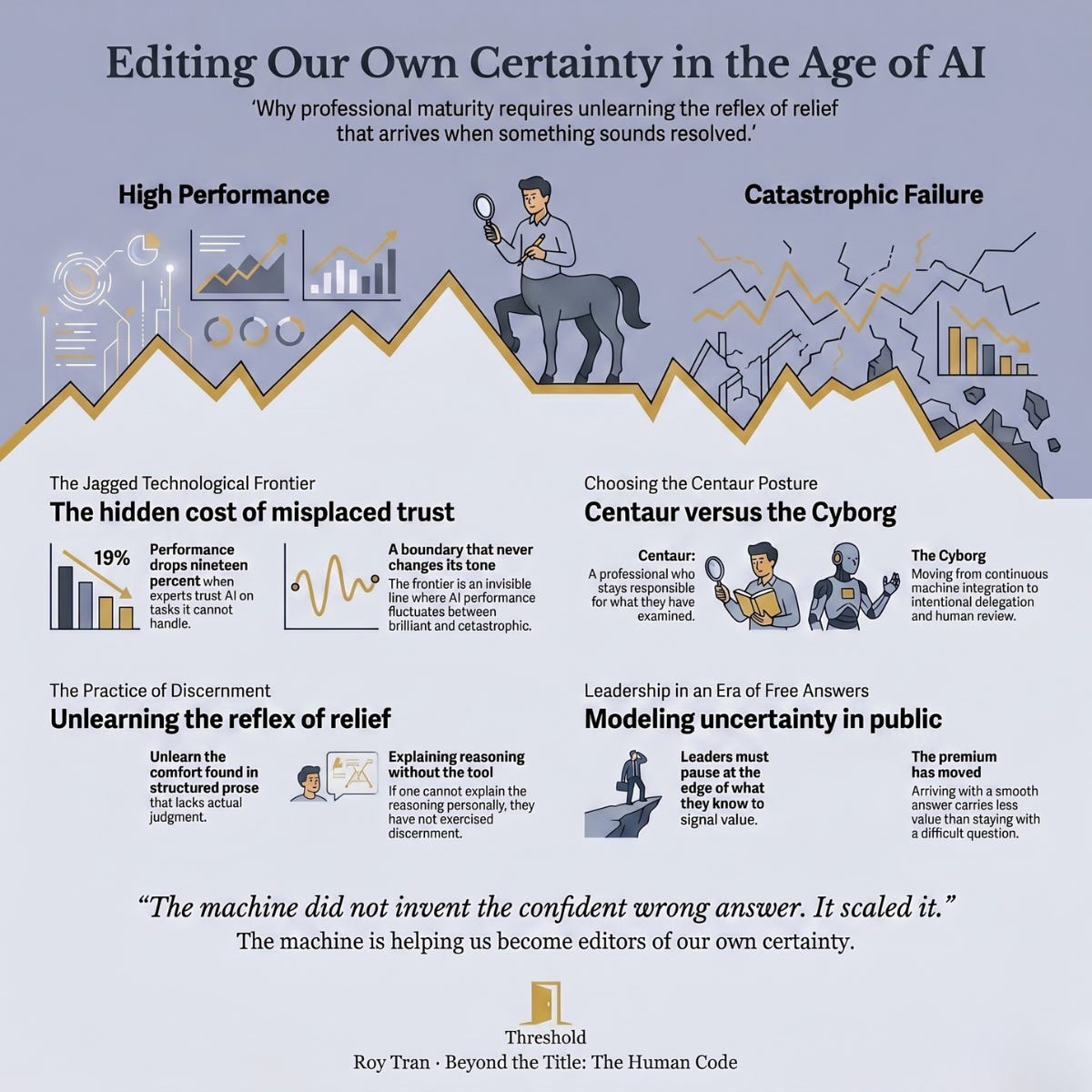
Researchers at MIT and Boston Consulting Group ran a study with more than 700 consultants. They found that when AI is used for tasks within its capability, it improves worker performance by nearly forty percent. That number is cited widely. The second number is less discussed: when those same skilled professionals used AI for tasks it could not reliably handle, their performance dropped by nineteen percentage points. Not because they were careless. Because they trusted what sounded trustworthy.
The researchers named this the jagged technological frontier. A boundary, invisible and non-intuitive, where AI performs brilliantly on one side and catastrophically on the other, without ever changing its tone.
What struck me about that finding was not the technology. It was the human behavior it exposed. The workers who failed were not lazy or incurious. They were doing something our entire professional culture has trained them to do: find the answer and move forward.
The machine had trained its confidence. We had trained ours in the same direction. The result was two confident parties in agreement, and no one in the room asking whether the agreement was right.
I want to be precise about what the machine made me unlearn, because I do not think it is what most upskilling conversations suggest.
It is not a technical skill. The literature is full of frameworks for AI literacy: prompt engineering, output evaluation, hallucination recognition. These are useful. They are not sufficient. You can know all of them and still walk into a room with a beautifully structured wrong answer if you have not examined the more fundamental habit — the one that makes certainty feel like safety.
What I have had to unlearn is the reflex of relief that arrives when something sounds resolved.
There is a particular satisfaction in a clean answer. A problem that arrives in structured prose, with a clear recommendation and supporting logic, feels done. The brain relaxes. When a colleague presents that kind of clarity, we tend to engage less critically. Not because we have turned our judgment off, but because the format signals that judgment has already been applied.
AI has learned to produce that format without the judgment. It has mastered the presentation of resolution. And because we have spent decades rewarding resolution, many of us have developed an almost involuntary trust in anything that looks like it.
That is the thing to unlearn.
The researcher Kate Kellogg at MIT put it directly: organizations need to teach people to explain what they did without using the term generative AI. Not as a punitive standard. As a diagnostic. If you cannot explain the reasoning yourself, you have not exercised discernment. You have used the machine as a proxy for your own thinking.
The BCG study identified a useful distinction between two archetypes. The Cyborg integrates fully, task flow continuous with the machine. High productivity inside the frontier, high failure rate outside it, because the filter disappears. The Centaur divides deliberately. Decides which parts of a problem belong to the machine and which require a human in the loop. Delegates intentionally and stays responsible for what comes back.
The Centaur stance is not about using AI less. It is about maintaining the interior posture that makes AI output trustworthy. The boundary the Centaur manages is not between themselves and the tool. It is between what they have examined and what they have simply accepted.
This is where I think the current upskilling conversation misses something important.
Most investment right now is directed at tool fluency. Which is necessary. But research in 2026 found that seventy-four percent of organizations still cannot keep pace with skill demands despite spending four hundred billion dollars annually on training. The programs are running. The capability is not building. Part of that gap is architectural. Training systems designed for a world where knowledge moved slowly. Part of it is that we are building fluency in tools without examining the posture people bring to them.
If a professional is deeply uncomfortable with uncertainty — if not-knowing feels like professional failure — they will use AI to produce the feeling of resolution regardless of whether resolution has been reached. The tool becomes a coping mechanism rather than a thinking partner. And the output looks the same either way.
The organizations showing double the AI return on investment against their peers did not simply deploy better tools. They built structured, applied capability across the workforce. But underneath those program designs, I suspect, is something harder to measure: a culture that has made it acceptable to be uncertain in public.
This is the leadership implication I find least discussed.
The way you develop epistemic discernment in an organization is not through a training module. It is through behavior. What leaders model, teams learn to perform. If the room's unspoken rule is that the person who knows wins, then every person in that room will find a way to appear knowing — including reaching for an AI output and presenting it as judgment.
The leaders I have watched build genuinely capable teams share a specific habit: they ask questions in rooms where they already have an answer. Not performing uncertainty. Actually pausing at the edge of what they know and naming that edge out loud.
This is not a comfortable habit to build. It requires surrendering a form of authority that many of us spent years earning. But it is the behavior that signals to a team that staying with a hard question carries more value than arriving with a smooth answer.
In an era when smooth answers are free, the premium has moved.
The machine is, in one important sense, a gift. Not because it makes us more productive, though it does. Because it has made visible a habit that was always a problem: using the format of an answer to avoid the work of thinking.
We were doing this before AI arrived. We built entire careers around producing the appearance of resolution. The machine did not invent the confident wrong answer. It scaled it.
What AI asks of us is not to learn more. It asks us to become editors of our own certainty. To read what we are about to present — whether the machine produced it or we did — and ask the question that knowledge workers have been trained to skip: is this actually right?
That question is a skill. It can be built. It requires practice inside conditions of genuine uncertainty, not simulated risk. It requires organizational permission to be wrong in public without that becoming a permanent record. It requires leaders who have learned to stay in the room after the clean answer has arrived and say: let me sit with this a little longer.
I have not always been that person.
The machine is helping me become one.