Beyond the Title
What the Digital Native Myth Is Costing Organizations
When experience becomes a liability, judgment walks out the door
There is a term circulating in career coaching circles: Resume Botox.
It refers to the practice of professionals editing graduation years, early career dates, and any marker that might allow a recruiter to calculate their age off a profile or CV. People with twenty, sometimes thirty years of organizational experience are erasing the evidence of it. Not because they are ashamed of it. Because they have read the room.
I have sat in the conversations where the room is created. Where leaders, under genuine pressure to move fast, reach for the language of "AI native" to make capability decisions that should be far more careful. I have watched organizations reorganize their talent strategies around a generation rather than a skill. I have watched experienced people read those signals and begin, quietly, to make themselves smaller.
This is the problem I want to name. Not as a defence of older workers, and not as a skepticism of AI. As a diagnosis of a category error that is embedding itself into workforce strategy at exactly the moment it will do the most damage.
The "digital native" concept has a clean, intuitive logic. Young people grew up with smartphones and algorithms. They move through digital tools the way older workers move through spreadsheets. They are comfortable where others are uncertain. The leap from comfort to competence, from familiarity to strategic judgment, seems short.
It is not short.
A study published in MDPI found that while university students adopted accessible AI prompting patterns readily, the approaches requiring logical structuring, recursive reasoning, and linguistic nuance posed significant challenges. These more advanced capabilities, the kind that make AI genuinely useful in high-stakes organizational decisions, were not distributed by age. They were built through practice, through structured development, through the willingness to sit with complexity. Generational membership did not predict them.
What did predict them? The same things that have always predicted quality judgment: deliberate experience, analytic discipline, and the intellectual humility to know when a confident-looking output is wrong.
Organizations promoting their youngest cohorts into AI leadership roles because those cohorts are comfortable with the tools are making a category error. They are confusing fluency with wisdom. A person who moves through a platform easily is not automatically the person best positioned to decide what the platform should be used for. And right now, most organizations are not separating those two things.
Here is the cost that is not showing up in the quarterly reports yet.
KPMG research found that 57 percent of HR leaders believe their workforce must evolve in size and skill within three years. Only 25 percent of organizations have the capability to make that happen. I want to sit with that gap for a moment, because it is not an abstract statistic.
Somewhere inside that gap is the manager who has spent fifteen years understanding why a particular process works the way it does. Not because of the procedure manual. Because she was in the room when three previous attempts failed. She knows what the documentation does not capture. She knows the exceptions, the edge cases, the relationships that hold the system together when the formal structures bend under pressure.
She is also 54 years old. She has a graduation year on her profile. Her organization is, right now, in some version of a "future skills" conversation that is not quite finding her.
When she leaves, the organization will not immediately notice what it lost. The AI system will continue producing outputs. The dashboards will look fine. Eighteen months later, something will break in a way nobody can quite explain, because the explanation lived in the institutional memory that walked out with her.
This is the compounding risk that most AI adoption strategies are not pricing in. Organizations are accelerating into AI deployment at the exact moment they are hollowing out the contextual intelligence that makes AI deployment safe. The guardrails are leaving the building before anyone has mapped where they stood.
A Cornell University study published in Personality and Individual Differences found that employees who respond favorably to vague corporate jargon score significantly worse on tests of analytic workplace decision-making. The researchers described the dynamic plainly: rather than a rising tide lifting all boats, empty rhetoric acts more like a clogged toilet of inefficiency.
There is a specific application here that I think about often.
If an organization is using "digital native" as a capability filter, and that filter is built on cultural assumption rather than rigorous assessment, it is doing the same thing the jargon-receptive employees are doing. It is allowing language that feels strategic to substitute for analysis that actually is. The organizations most vulnerable to poor AI decision-making are not the ones lacking tools. They are the ones where the thinking about who should use the tools has already been done loosely.
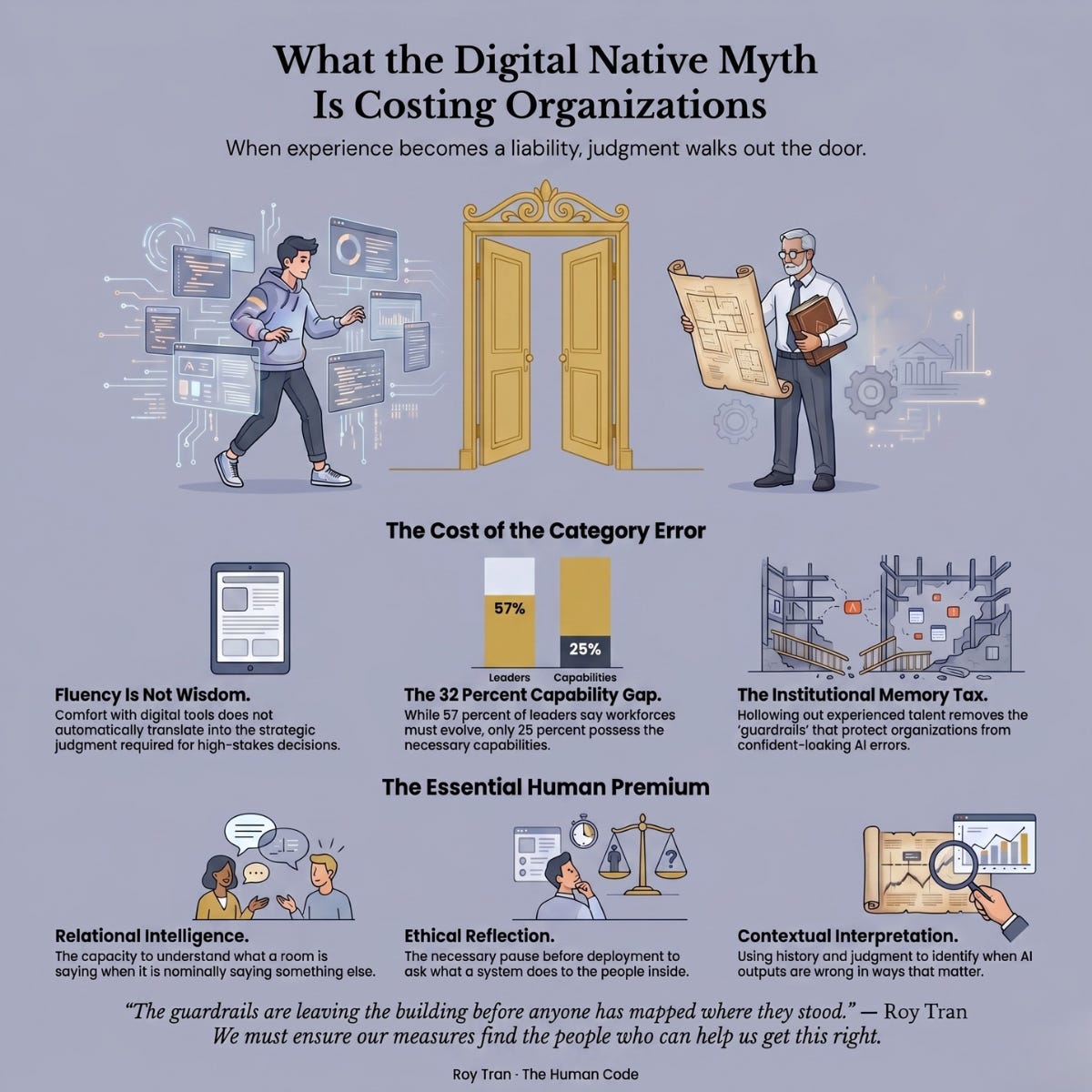
The three capabilities that determine whether AI makes an organization more effective or more brittle are relational intelligence, ethical reflection, and contextual interpretation.
Relational intelligence is the capacity to know what the room is actually saying when it is nominally saying something else. To understand why this particular stakeholder is asking this particular question right now, and what is behind it that the AI summary did not capture.
Ethical reflection is the pause before deployment. The willingness to ask what this system will do to the people inside it, not just what it will do for the metrics.
Contextual interpretation is knowing that the AI output in front of you is probably right, sometimes wrong, and occasionally wrong in ways that matter enormously, and having the history and judgment to tell the difference.
None of these capabilities arrives with a birth year. They compound over time. They grow through failure, through organizational history, through the accumulated weight of watching the same problem arrive in different clothes across different seasons.
An OECD survey found that 89 percent of respondents agreed that older workers perform at least as well as, and often better than, their younger counterparts when given the opportunity to demonstrate it. The problem is structural. Organizations are not extending that opportunity, because the question being asked about AI readiness is not a capability question. It is a generational assumption wearing capability language.
The path forward is not complicated in design. It is demanding in discipline.
Structured reverse mentoring, built with genuine intention, moves knowledge in both directions. The junior colleague brings platform literacy and experimentation speed. The senior colleague brings organizational context, political intelligence, and the risk awareness that comes from having seen what breaks and why. Paired together, they produce better AI outputs and better AI decisions than either produces alone. Capgemini research found that 62 percent of Gen Z workers are already doing this informally. They are already helping senior colleagues find their footing with new tools. What is missing is not the will. It is the formal design that makes it sustainable and reciprocal.
Skills-based assessment replaces the generational shortcut with an actual diagnostic. What does this work require? What judgment, what history, what technical fluency? What does this person carry, and what needs to be built alongside it? These questions take longer to answer than a date calculation. They are worth the time.
KPMG found that 62 percent of employees say a company's investment in upskilling directly influences whether they stay. Organizations building age-inclusive capability strategies are not just managing retention risk. They are protecting the institutional foundation that determines whether their AI investments produce value or produce confident-looking errors at scale.
The Resume Botox is a rational response to an irrational signal.
The people editing themselves smaller are not being defeated. They are adapting to what their organizations are communicating, without saying it directly, about whose experience counts and whose does not. They are making the only move available to them inside a system that has already decided they are the wrong kind of ready.
The organizations creating those signals will not feel the consequence immediately. But they are already paying for it. In the decisions being made without the full context. In the AI outputs being accepted without the scrutiny they require. In the guardrails walking quietly out the door while the dashboard shows everything is fine.
The question I carry into every workforce conversation I sit in now is this: what are we actually measuring when we say AI readiness? And are we honest about whether that measure is finding the people who can help us get this right, or simply the people who look the part?
Your organization is giving people an answer to that question right now. The question is whether it is the answer you intend to give.