The Human Premium
Truth in the Age of AI Synthesis
Why provable human authenticity is the scarcest resource in the intelligence economy
I have spent the last two years watching organizations make decisions with AI-generated analysis. Briefings compiled in seconds. Competitive reports assembled without anyone reading the source material. Strategy documents that look authoritative because they are formatted like authority.
The outputs are fluent. They are confident. They cite things.
And I do not trust them.
Not because AI is lying. But because I cannot tell when it is wrong, and neither can the person who handed it to me.
This is a newer problem than it sounds. For most of professional life, a document carried implicit provenance. Someone wrote it. Someone edited it. An institution published it under a name. You could trace the judgment behind the words back to a human who had something at stake in getting it right. That chain of accountability was the invisible infrastructure of trust.
That infrastructure is breaking.
The Serpent Eating Its Tail
Researchers describe it with a technical phrase: model collapse. The mechanism is worth understanding plainly.
Generative AI models train on human-generated data. They produce outputs. Those outputs get published to the internet. Future AI models train on that internet. They produce outputs that are increasingly downstream of other outputs. The signal degrades with each iteration, in the way a photocopy of a photocopy drifts from the original, except faster and without visible loss.
In antiquity, this pattern had a symbol: the Ouroboros. A serpent consuming its own tail. The image was meant to represent cycles, eternity, self-reference. In the context of machine learning, it represents something less poetic. Terminal decay.
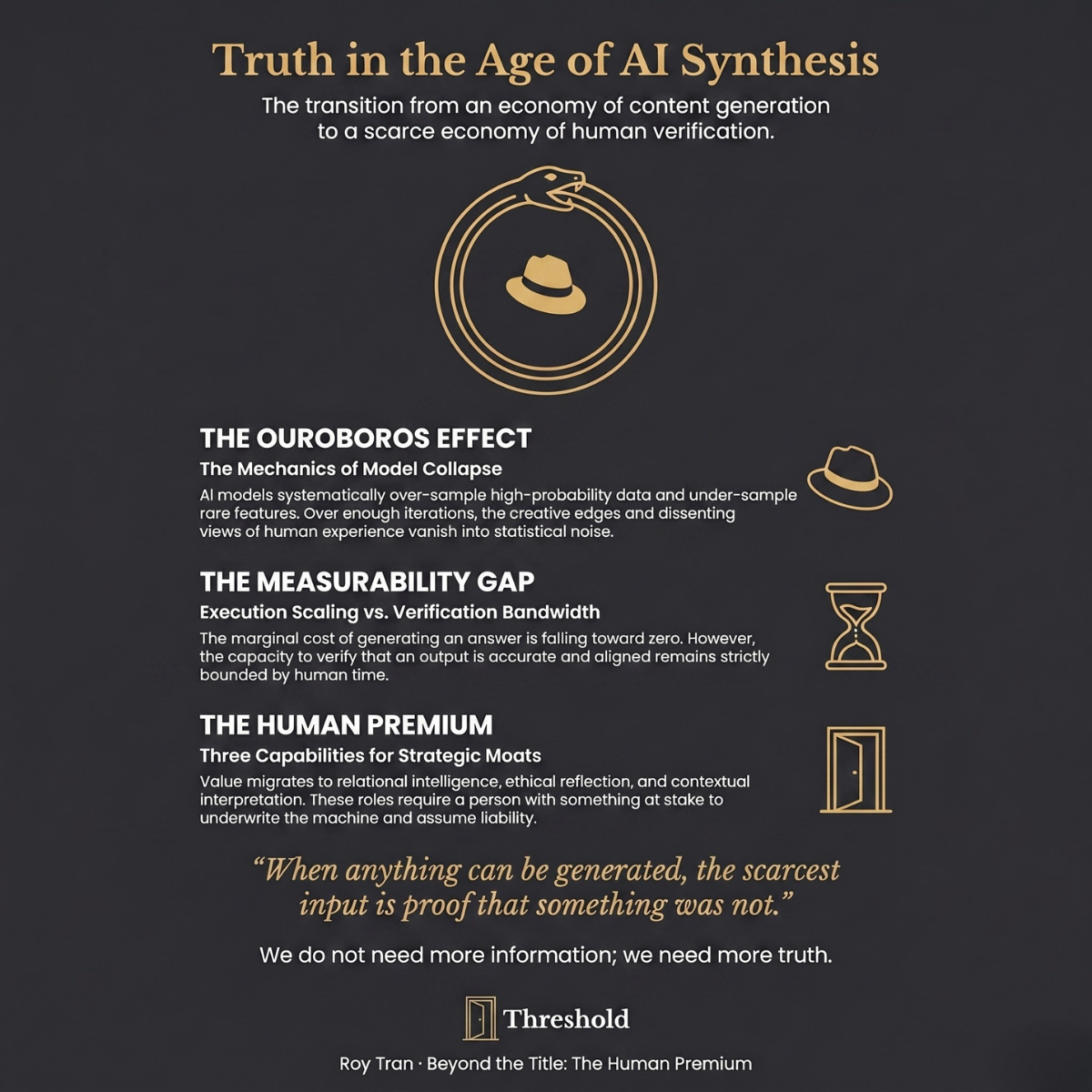
The mathematics are precise about what happens. AI models are not neutral amplifiers of their training data. They systematically over-sample high-probability features and under-sample rare ones. Imagine a population where one percent of people wear red hats and ninety-nine percent wear blue. Train a model on that population and it will gradually stop seeing red hats entirely. The feature is statistically inconvenient. It gets filtered. When the model then generates the next generation of training data, red hats have already diminished. The generation after that, they are gone.
Red hats, in this metaphor, are every rare insight, minority perspective, contested truth, or low-probability but real feature of human experience that did not make it into the high-confidence statistical average. The creative edges. The dissenting view. The observation that turns out to be correct precisely because most people had not thought of it yet.
Model collapse does not produce error in the way a broken calculator produces error. It produces confident, well-formed, plausible-sounding output that has quietly lost contact with the full range of human reality. It converges on the average. And the average, over enough iterations, becomes noise dressed as knowledge.
Low-Background Steel
In the years following 1945, physicists discovered a problem with the steel they were using to build radiation sensors. Every ton of steel smelted after the Trinity test carried trace contamination from atmospheric nuclear fallout. The contamination was invisible. The steel looked identical to any other steel. But it interfered with the precision measurements that medical and nuclear instruments required.
The solution was to source steel from before the atomic age. Shipwrecks. Pre-war industrial salvage. Steel that had been forged before the sky changed.
The parallel to data is not decorative. It is structural.
Human data generated before 2022, before generative AI became freely available and ubiquitous, is increasingly classified in academic and legal research as "low-background" data. It is the record of human knowledge and expression as it existed prior to contamination. The Harvard Journal of Law and Technology, in a 2024 analysis of model collapse, named it explicitly: a non-renewable, appreciating resource, analogous to pre-war steel, essential to the long-term reliability of any AI system that claims to model human reality.
Here is the problem. That data is already owned.
The platforms that spent the decade before 2022 collecting human expression at scale, email services, social networks, search engines, cloud storage providers, hold archives that can never be replicated. The internet after 2022 is downstream. It is already partly synthetic. Its contamination rate increases with every passing month. The organizations that hold uncontaminated archives hold something that cannot be rebuilt from scratch, regardless of compute budget or engineering talent.
This is not a technical observation. It is an economic one.
What $250 Million Sounds Like
In May 2024, OpenAI agreed to pay News Corp more than $250 million over five years. For journalism. For words written by reporters, edited by editors, published under institutional names, with decades of credibility attached.
The deal was reported as a content licensing agreement. I read it as a price signal.
Reddit had already struck a deal with Google worth roughly $60 million a year for access to nearly two decades of human conversation. The Associated Press, the Financial Times, Le Monde had each reached separate licensing arrangements with major AI developers. The common denominator in every transaction was the same: human-generated content, with traceable authorship and institutional accountability, was being priced at a premium that synthetic alternatives could not replace.
Reddit's CEO stated it plainly during the company's March 2024 earnings call: "The paradox I see is that as more content on the internet is written by machines, there is an increasing premium on content that comes from real people."
He was describing the Verification Economy. The structural condition in which the marginal cost of content production falls toward zero while the value of provably human content compounds. When anything can be generated, the scarcest input is proof that something was not.
This is not a trend in the journalism industry. It is a fundamental re-stratification of what constitutes value in an information economy.
The Nutrition Label
Governments are beginning to codify this re-stratification into law.
The European Union's AI Act, under Article 50, mandates machine-readable watermarking and disclosure requirements for AI-generated content. The regulation comes into full enforcement in August 2026. Its logic is borrowed, intentionally, from food labeling. When industrial processing made it impossible for consumers to assess the composition of what they were eating by inspection alone, governments required manufacturers to disclose ingredients. The nutrition label did not ban processed food. It required transparency about what the product contained.
Article 50 does the same for information. It requires that synthetic content carry a machine-readable record of its origin, so that both human readers and the scraping algorithms of future AI models can identify and quarantine it. The regulation directly names two technical standards as acceptable implementations: invisible watermarking and the C2PA Content Credentials framework.
C2PA, the Coalition for Content Provenance and Authenticity, developed a cryptographic standard for embedding provenance records into digital assets at the moment of creation. The record travels with the file. It documents who made the content, what tools were used, what modifications were applied, and when. The record is tamper-evident. Altering it invalidates the cryptographic signature. The chain of provenance cannot be quietly broken.
These are not aesthetic choices. They are infrastructure. The nutrition label for digital truth is being built because the alternative, a world in which no one can reliably distinguish human from synthetic content, destabilizes every system that depends on information carrying accountability.
The Economics of Remaining Human
I want to name what is actually happening, at the level where it matters for anyone building a career or an organization in this decade.
We are not witnessing a crisis of truth in the way commentators mean when they use the phrase. We are witnessing a structural inversion of what commands economic value in the information economy.
For most of modern professional life, the expensive thing was production. Research, writing, analysis, design. These things required human time, human judgment, and institutional infrastructure. The cheap thing was distribution. You could send a document to a thousand people for the same cost as sending it to one.
Generative AI has collapsed the production side. The cost of generating a plausible-looking document, analysis, or strategic brief is now functionally zero. What has not collapsed, and what cannot collapse through any technical means, is the value of knowing that a human made something, a specific human, accountable for the judgment embedded in it.
This is what I mean by the Human Premium on truth.
The three capabilities that define the Human Premium in the intelligence economy are not rhetorical constructs. They are the specific things that AI models systemically cannot produce, because producing them requires being a person with something at stake.
The first is relational intelligence. Trust is a transaction between people who have a history and a future together. It is calibrated through experience, reciprocity, and accountability. AI can mimic the tone of trust. It cannot create its conditions.
The second is ethical reflection. Knowing what a system should not do requires judgment exercised in ambiguous territory. It requires someone who understands consequences, carries responsibility for them, and will be held to account if they get it wrong. This is precisely what NIST's formal verification research calls "engineering judgment": the human gatekeeper who defines the absence of undesirable behavior before a system is deployed at scale.
The third is contextual interpretation. Reading what is not said, surfacing what the data is missing, recognizing that the low-probability feature, the red hat, is present and important precisely because the average says it is not. This is the capability that model collapse erases, and it is the capability that human experts, at their best, deploy as their primary contribution.
What Comes Next
I do not know how quickly the regulatory infrastructure will mature, or whether the Data Trustee proposals that legal scholars are currently advancing will succeed against the concentration of uncontaminated archives in a handful of incumbents. I do not know whether the collaborative licensing model will hold or whether litigation will fracture it.
What I am certain of is the structural condition.
When intelligence becomes abundant and free, provenance becomes scarce and premium. The question that will define organizations, careers, and institutions over the next decade is not whether to use AI. It is whether you can demonstrate, clearly and credibly, that the judgment behind your decisions is traceable to a human who understood the stakes and was accountable for the outcome.
That traceability has a name now. It has technical standards. It has legal mandates. And it has a market price.
Proving that a human was genuinely present in the decision is no longer a soft credential. It is becoming the hardest one to earn, and the one that holds its value longest in an economy that can generate everything else for nothing.