The Human Code
The Wi-Fi That Crossed Borders
What chasing signal across airports taught me about the distance between connectivity and care.
The first time I chased Wi-Fi like it could save my life, I was sitting cross-legged on the tiles of an airport in Mumbai, leaning against a pillar that had likely witnessed more prayers than laptops, watching my phone circle a signal like a shy cat deciding whether I was trustworthy. It was the kind of late where the lights hum louder than people, and the announcements sound like they're apologizing for existing. A colleague had assured me, with the blind faith of a man who's never met a captive portal, that "the airport Wi-Fi is strong." It was not strong. It was a rumor wrapped in a login screen, a promise that asked for a local number I didn't have, a PIN it refused to send, and a surname that somehow didn't match the name on my own passport. I typed and retyped like a penitent entering confession, then held the phone at different angles as if gravity might convince the router to forgive me. Around me was a quiet congregation of the same faith: faces tilted to the same cold blue light, shoulders curved into the same question, am I connected enough to matter?
Airports are honest mirrors. They flatten rank faster than turbulence and prove that most of us can be reduced to two states: uploading and waiting to upload. Every city had taught me a different ally in this hunt. In London, you stood by the pretzel kiosk because some smart person had mounted the router above salt and dough. In Singapore, you collected a password printed neatly on a receipt as if affection came with your latte. In Hanoi, you learned to sit beneath the plastic fig tree where, for reasons no engineer could explain, the air itself held an extra bar. I balanced conference calls on my suitcase, used a shoe as a tripod, and learned the body language of signal: the way a head cocks right before the connection catches, the way breathing pauses when an attachment hits 97%, the way strangers drift together in the shadow of the same invisible ladder. I did ridiculous things with the solemnity of ritual. And somewhere between ridiculous and ritual, I mistook connectivity for care.
The Wi-Fi that crossed borders didn't just live in routers and ceilings. It lived in people who pocketed codes like recipes and passed them on with the intimacy of a favor you didn't deserve. In Hong Kong, a bellman folded a list of secret SSIDs into my hand, each annotated with what it could carry. "Use #3 for big files," he whispered, a pharmacist dispensing contraband antibiotics. In Manila, a barista slid me a slip of paper that simply read "try this," and I wanted to thank her by naming a child after her. In Toronto, the password was always "guest," a word that told you everything about our politeness and nothing about belonging. In Tokyo, the code arrived with a bow, and you felt briefly that technology could be tender. In Saigon, passwords were phone numbers printed on the chalkboard like an invitation and a boundary: you can be here, but please don't pretend you live here.
When my work began to require more air than ground, I kept a small notebook of networks the way some people keep journals of gratitude: where to stand, who to ask, how to borrow. It reads like a travelogue of invisible kindness: the duty-free corner in Doha where the bars were inexplicably brave, the bench in Delhi that sat directly beneath a benevolent vent, the lounge in Narita where the staff would type the password for you as if to spare you the indignity of misremembering. And, on a page smudged by the heat of someone's rooftop, the mesh network in Nairobi where a small team of neighbors perched plastic nodes like sparrows on parapets until each tiny box found the next and the whole neighborhood learned to pass signal like a story. "If one goes down, the others talk around it," the lead said. I didn't write it down for a presentation. I just wrote it down.
It would be charming to say I needed Wi-Fi only for work, but I wanted it for proof. Connection meant witness. A green dot meant I existed in other people's mornings. A reply meant I was still in orbit. When the dot went dark, I became a rumor even to myself. In a remote part of southern India, the local manager said, with a smile that made it land like poetry, "We have internet, but it is shy." For three days it hid from me. No pings, no updates, no corporate "Happy Tuesday!" subject lines dressed like morale. The first night, my hand kept floating toward the phone like a phantom limb. The second, the ache softened into a sort of silence I recognized from childhood, when evening meant voices and a sky too big to measure. By the third, conversations had lengthened into laughter. Dinner had stopped measuring itself against meetings. When the connection returned, my inbox disgorged two hundred and something messages. I watched them download like a wave and felt less rescued than re-arrested.
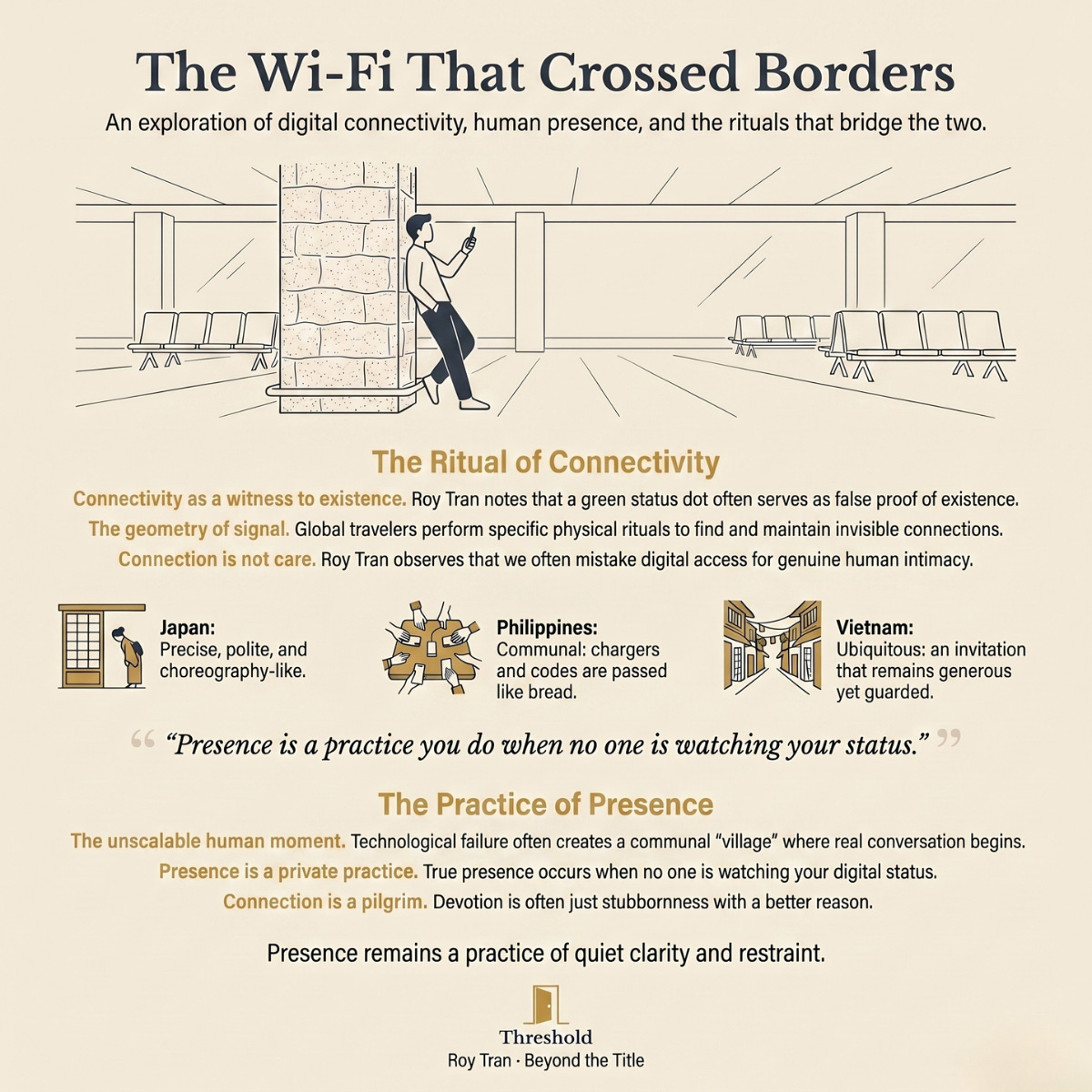
Every country taught me something new about the hierarchy of signals. In the Philippines, connectivity felt communal. Codes were social objects; chargers were passed like bread. People leaned toward one another to become better antennas. In India, the signal was traffic: chaotic, creative, alive, arriving through problems instead of around them. In Japan, it was choreography. Precise, polite, exactly on time, apologizing for being exactly on time. In Vietnam, where I live now, it is everywhere, and everywhere the password is a reminder that access is both generous and guarded. And then there were the places where connection was still a pilgrim. In a village outside Cebu, a teacher climbed a hill each dawn to submit attendance because the classroom could not reach the sky; she called it "exercise" and then laughed in a way that made you understand devotion is just stubbornness with a better reason.
Humor is what saved me from becoming entirely ridiculous. In Hong Kong, I once prayed to a captive portal. It had trapped my screen behind an agree-to-everything box that would not scroll, and I whispered, "Come on, just one file," like a child bargaining with bedtime. When it finally surrendered, I said thank you to a machine with the sincerity normally reserved for second chances. On a transatlantic flight, the onboard Wi-Fi died with a little chime of surrender somewhere over Greenland, and a groan rippled down the cabin like weather. Laptops closed like disappointed pets. An executive across the aisle announced, to no one, "How will I work?" After hour five of enforced irrelevance, something human happened. People started talking. Not networking, which is the performance of talking, but actual conversation. A man drew a map of his hometown on a napkin. A woman admitted she was afraid of landing more than flying. Someone produced chocolate with the ceremony of an apology. It was awkward and generous and entirely unscalable. When the wheels touched down and phones found their towers, the sea creatures slid back into their screens, and I missed the silence almost immediately.
There is a particular comedy to the way executives behave when the outlets in a conference hotel are fewer than the number of devices they brought to feel indispensable. In Paris, I watched a ballroom of leaders choose seats entirely by socket proximity, then pretend it was about "cross-functional pairing." The keynote promised "enterprise-grade Wi-Fi," and we applauded as if that were enough. Ten minutes later, two thousand hungry devices did what hungry things do, and the network collapsed like a promise. Slides died mid-bullet. People looked up, squinting, and remembered they had voices. The room devolved into what it should have been all along: a village. Ideas unprojected. Questions without microphones. Laughter unmuted. We survived.
My mother used to say, "Call when you land," with the kind of gravity that made the phrase feel older than phones. She did not mean "send a thumbs-up from the arrivals hall." She meant: be real somewhere in the city that just changed you. Early in my career, I mistook instant replies for love languages and being "always on" for being good at being alive. I answered messages from bathrooms because the acoustics were private and the Wi-Fi could not hear me panic. I wore the green dot like a small medal, proof that if anyone needed me, I could be consumed in real time. Over time, I learned the vanity hidden inside that generosity. Presence is a practice you do when no one is watching your status.
Of the many little cults that thrive in airports, my favorite is the quiet brotherhood of people who know where the beam lives. We can find each other by posture. We offer each other stools near certain columns and explain the geometry of signal with the seriousness of gossip. Once, at Gate A7, a woman sat down beside me, placed her phone directly on my laptop without asking, and said, "We're in this together." It was the most honest sentence spoken that day. She sent three emails the way you throw ropes. When her attachments sailed, she lifted the phone like a rescued animal and set it down. I have launched products without feeling as useful as I felt in that moment.
What's the moment you mistook connectivity for care? The flight where Wi-Fi died and something human happened? The night the dot went dark and you found you were still there? Drop it below. The handwritten internet still works.