The Human Premium
The Dividend
What well-orchestrated AI deployment actually pays
Most of what gets written about AI inside companies frames the trade-off the same way.
You automate, you cut costs, you get more done. The work gets a little less human, the output gets a little less original, the team gets a little more anxious. You have made a choice between speed and substance, and the bill comes due later.
The data does not support that frame.
Inside HR teams that deploy AI well, three numbers move together. Efficiency goes up 87%. Work quality goes up 75%. Creativity goes up 66%.
That last number is the one that should make you pause. Creativity is the thing AI is supposed to threaten. In well-orchestrated deployments, creativity rises by two thirds.
This is the dividend.
It is not a tradeoff. It is a compounding return that arrives only when the deployment is done with care.
Most companies are not getting it.
What most companies are getting
The conventional AI deployment looks like this. A team identifies a high-volume task. They route the task to a model. The task gets done faster. They count the time saved. They report the productivity gain to the board.
What gets lost is the part that does not show up in the dashboard.
The original judgment that used to live inside that workflow is gone. The team that used to think about the task no longer thinks about it. The institutional knowledge that came from doing the task by hand erodes. The output looks more or less the same on paper, but it is now produced by a process nobody on the team understands deeply.
You get the 87%. You lose the 75% and the 66%.
What you have built is not a more capable team. It is a faster team producing slightly worse work, and you have lost the people who could tell you the work was worse.
The three tiers
There is a different way to think about deployment.
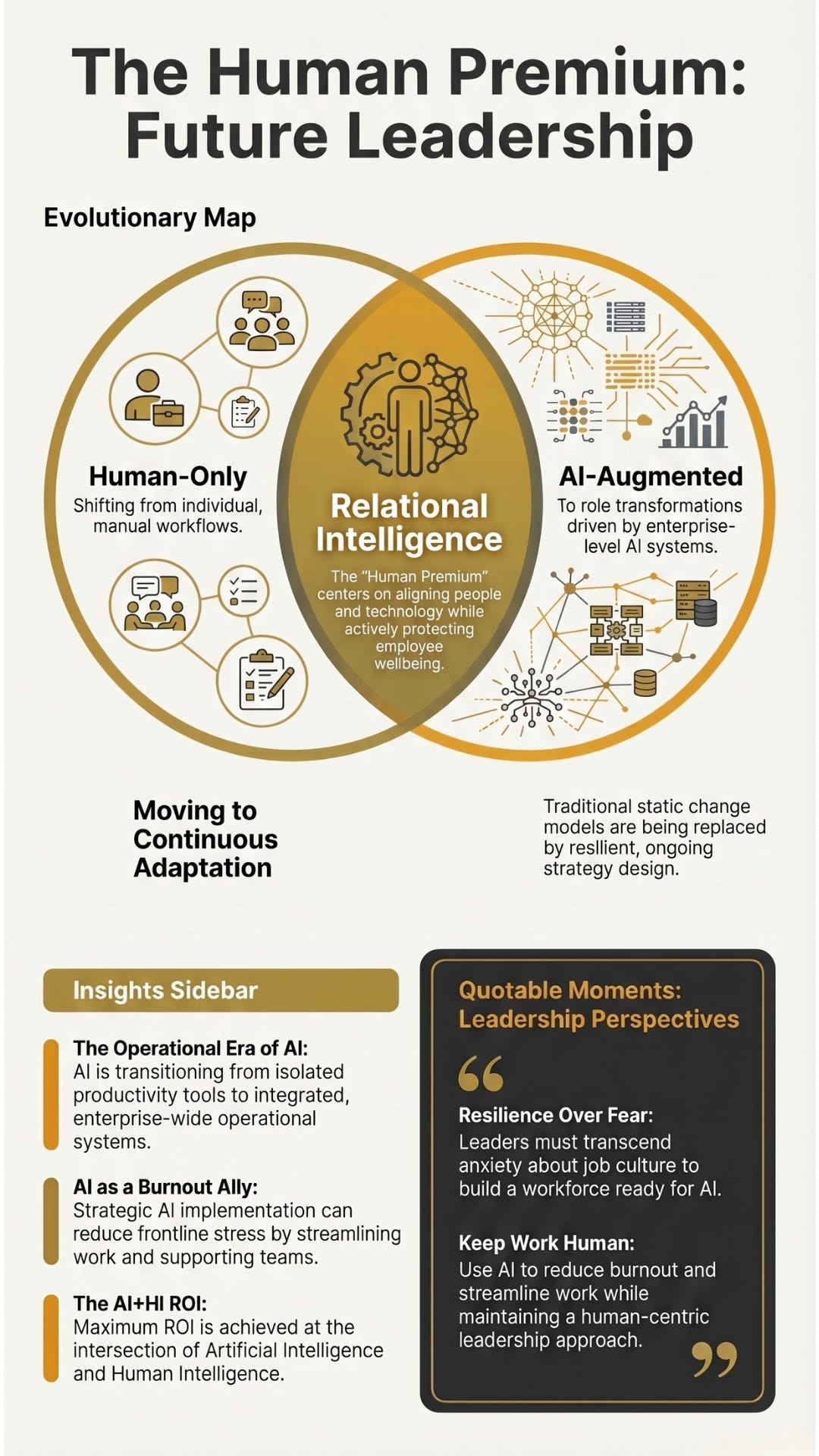
Inside any workflow, there are three tiers of work.
The human-only tier is the work that requires high empathy, ethical oversight, and complex interpersonal strategy. Designing a redundancy. Holding a difficult performance conversation. Reading the room when a team is shifting. Choosing which version of an organizational truth to tell.
The AI-augmented tier is the work the model can absorb. High volume, well-defined, repetitive. Resume screening. Interview scheduling. First-pass policy summarization. The kind of work where speed matters more than judgment, and where the cost of an occasional error is small.
Between the two sits the tier most companies miss. Strategic Orchestration.
Strategic Orchestration is the work of deciding which task goes where. Which output to trust and which to interrogate. When to override the model. How to coach a team through a workflow that now has a non-human collaborator in the middle of it. Which redesigns to make this quarter and which to defer.
This is leadership work. It is not delegation. It is choreography.
It is also the layer where the 60-point gap I named in an earlier essay actually closes. The gap closes when a human is doing the orchestration well.
The 75% and the 66% live in this tier.
What orchestration actually pays
When a leader is doing orchestration well, the team gets the efficiency from automation, and they keep the quality of output, because the leader is catching the errors that look right but are wrong.
The team also gets more creative, because the leader is freeing them from the mechanical work and pointing them at the harder problems where their judgment is irreplaceable. The 66% creativity gain is the dividend of being asked to do the work only humans can do.
This is what well-orchestrated deployment means.
The leader is not the bottleneck. The leader is the multiplier.
The three capabilities I named in the first essay of this series — relational intelligence, ethical reflection, contextual interpretation — are exactly the capabilities orchestration runs on. The dividend is what those capabilities actually pay out when they are applied with care.
The signal nobody is talking about clearly
Last week, Jensen Huang made a prediction that should reshape how we think about leadership compensation.
He said that within a few years, token budgets will become a standard recruitment incentive. Premium engineers will be paid not in dollars alone, but in access to AI capability. The amount of compute, model time, and inference budget you control will become a measure of how much you can build.
That is the engineering version of what is already true in leadership.
The leaders who get the dividend are not the ones with the biggest teams. They are the ones with the most thoughtful orchestration.
By 2027, global infrastructure demand for AI inference reaches roughly one trillion dollars. The capacity is going to be vast, and increasingly cheap. What stays scarce is the human capability to orchestrate it well.
Who gets the dividend
The leaders who get the 87% and the 75% and the 66% all together are not the leaders who deployed AI fastest. They are not the leaders who automated the most.
They are the ones who held the three tiers in mind, decided carefully where each piece of work belonged, and adjusted the choreography as the technology changed underneath them.
The Human Premium is paid to that work.
It is paid to the leaders who treat AI deployment as an orchestration problem, not an efficiency problem.
It is paid to the ones who understand that the dividend does not arrive automatically. It arrives only when someone with judgment is holding the middle.
The companies that win in this decade will not be the ones with the most AI.
They will be the ones with the most leaders who can orchestrate it.
If you have run an AI deployment that produced the dividend, efficiency and quality and creativity all rising together, I want to know what the orchestrator was doing. The pattern is becoming clearer to me, and the practitioners holding it are the ones I most want to learn from.
The person who comes to mind right now is who this was written for.
Send it to them.