The Human Code
The Camera That Found My Father
Before I understood leadership, systems, or culture, I learned how to pay attention in quieter ways.
Not in classrooms or offices, but in a small apartment where silence carried meaning, tools were given without instruction, and love was expressed through restraint rather than reassurance. Long before I had language for architecture, legacy, or impact, I learned what it meant to hold something steady and let it teach you.
This essay is not about photography in the technical sense.
It’s about how we learn to see.
About the quiet ways people pass on values without naming them.
About how tools, when used with care, reveal more about the human holding them than the image they produce.
The Camera That Found My Father is a personal essay, but it’s also an origin story. Not of a career, but of a way of looking. One that later shaped how I think about leadership, systems, and the invisible structures that either protect or erode what matters most.
This piece is available to read or listen.
The Camera That Found My Father
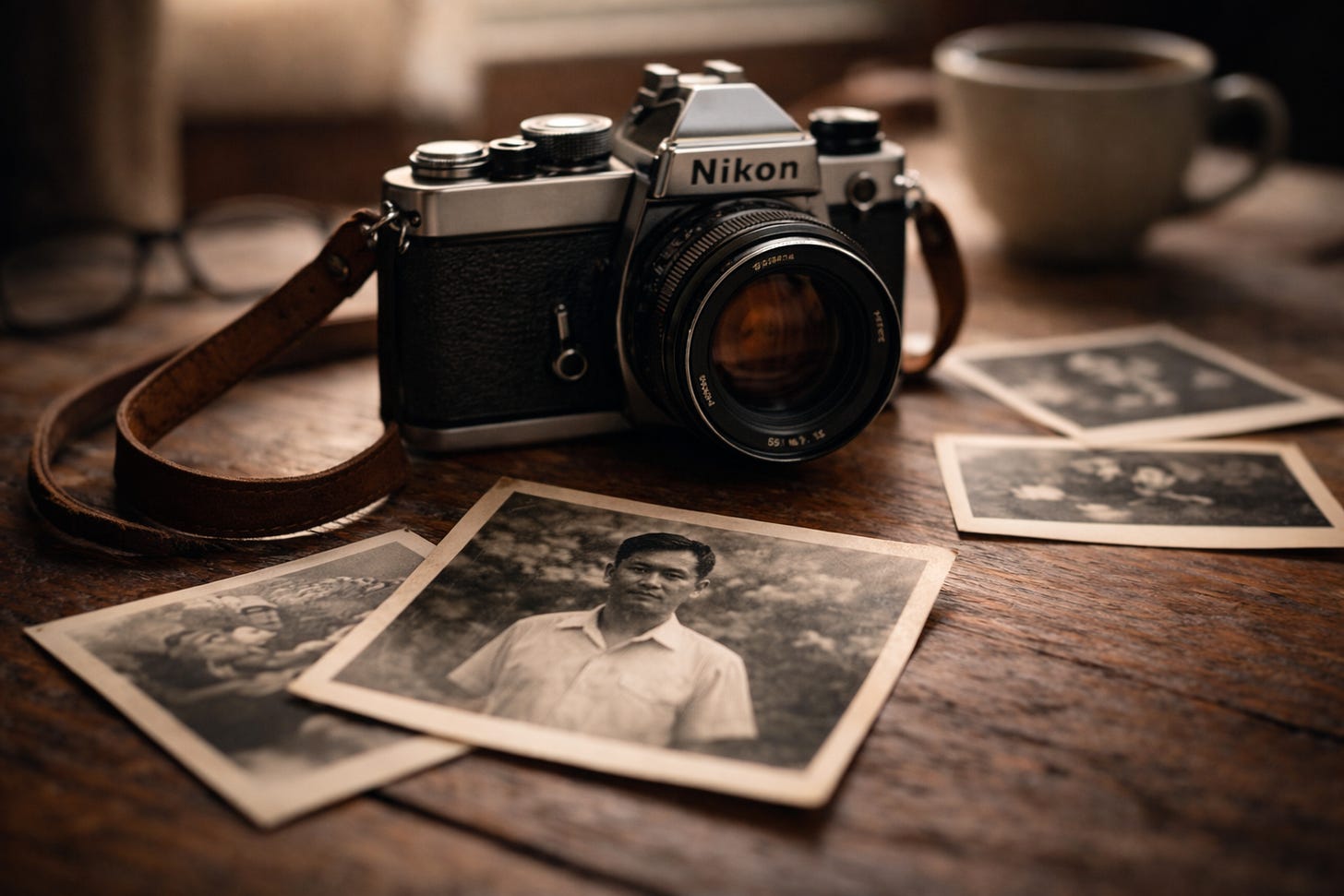
The camera came into my life the way important things do: without a speech or a ceremony, just a quiet handover at our small kitchen table in Canada. The kitchen had a thin laminate top that looked like wood and a leg that wobbled every time the fridge motor woke up with a cough. My dad put the camera down between the soy sauce and a chipped mug of Vietnamese coffee and didn’t say anything. He was not the type of person to make official announcements. He took small, thoughtful drags of his cigarette and looked at the world like it was giving him a test with no instructions. The camera was heavy and old. A Nikon that had seen better days, with a fixed lens and a few scratches that made it look like a soldier who had been through a small war. I picked it up with both hands, like you would pick up a sleeping baby that isn’t yours. It had the smell of metal and dust. It smelled good. You could tell it was something that could tell you some secrets if you were nice to it. He didn’t show me how to use it. My dad was very strict when it came to giving things away and following directions. He thought that giving you the tool and letting it teach you was the best way to learn. He always said that way you learn faster, but I learned that it means you learn slower and the learning doesn’t leave.
He didn’t buy the camera from a store with soft lighting. He had traded something with someone from somewhere. It came to our table like an immigrant who knew how to keep its head down. The strap hurt my neck. The shutter made a clean, honest sound. This was before cameras started to look like phones and phones started to act like friends. There was still a waiting period for film. You took a picture and then waited for the future to catch up to the past. I took my first picture of my dad. He was sitting at the same table with a cigarette between his fingers and a cup of coffee next to his elbow. His eyes were somewhere over my shoulder, as if the wall had asked him a hard question. I remember how my hands shook. Not out of fear. From paying attention. When you know that a moment is going to choose you, you shake a little. I pressed the shutter, and time stopped for me, as it does when it is being polite but firm.
My dad said that photography was the art of bending light. He said it like someone who didn’t want to offend someone else who believed in a superstition. I didn’t get how light could bend. It seemed like light was real. It was either on or off. Sunshine or not. Later, I found out that light was like a traveler who took different paths to get to you, and that if you opened and closed little doors in the right way, the traveler changed its mood. Speed of the shutter. Aperture. ISO. These names made me think of people who were very serious at a meeting. They became less official when I learned them myself. Shutter was a breath. The aperture was the heartbeat. ISO was the nervous system. The camera didn’t care about my grades, my handwriting, or the fact that kids at school called me names. It only wanted to know if I could be quiet. As a child, being still is not a skill that gets you praise. You can’t get a ribbon for it. In a small apartment where the walls heard every fight and the floors remembered every step, being quiet was a skill that kept the room from falling apart. I learned how to hold my breath well.
I began taking pictures of things that were free. That meant the world outside. The owner of the corner store is moving around a pile of lottery tickets. The same boys leaning against the same stairs and trying to look bored in three different ways. The woman who sold snacks out of a plastic tub and wore a wool hat in the summer. The park bench with a dent in the middle that looked like a tired back. People called them “street images” when they liked the way they turned out. When I saw the contact sheets, I wanted to crawl under the table and learn images. You have to be okay with being wrong in the dark and learning later in the light when you watch a movie. The apartment building was the same every day, which was good practice for noticing changes. The shapes of clouds. Colors of shirts. A smile that came out of nowhere. I learned that if you looked at the same scene long enough, it would tell you a different story. That might be what it means to grow up. Watching the same life until it stops pretending to be the one you first met.
I wasn’t brave enough to call myself a photographer when I was fifteen. I didn’t have any money, so the word felt expensive. I was a Vietnamese kid who had learned how to be small in hallways and hide in classrooms. The boys who wanted to hurt me never went into the library, so it was safe. I read more with my eyes than my brain while sitting between the art books and the photography books. Bill Cunningham was a man in New York who rode a bike and took pictures of people on the street. He said that the street told the truth before magazines learned how to lie. He wore a blue jacket that looked like a uniform for being nice. He took pictures quickly and then left. He didn’t stop to tell anyone what he had seen. He thought the picture would eventually give in. I liked that. Life doesn’t stop so you can explain. Life keeps going, and if you’re lucky, it will look back and smile. I wanted my own pictures to be that honest. The kind of honesty that didn’t need permission but always showed respect.
Back then, I didn’t get a lot of things. Why my dad didn’t say “I’m proud of you” like movies tell dads to. Why we only had two pairs of pants from the start of school until winter. Why did the people on TV have stairs in their houses and islands in their kitchens when our island was just a square table with one leg that complained? Television raised me in a useful way because it kept me busy while the adults worked their second jobs. I watched sitcoms from the 1980s at night. Families who smiled and solved problems in twenty-two minutes while fake applause played in the background. There was a show called Three’s Company that starred a man who fell over furniture in funny ways. People in Asia might not know his name. People in North America called him Jack Tripper, and he made them laugh by trying too hard. That was the trick. Try hard and make it look easy. Some people live that way. The camera showed me a new trick. Try hard, but make it look like you’re not trying at all.
My dad didn’t show me how to load film. He let me mess up two rolls without saying anything, and then he slid one across the table already threaded, like a dealer who wants you to win at least once so you keep playing. He said that the camera can see you even if you think you are the one looking. At first, that didn’t make sense. The way you hold a camera shows how you hold your life. The picture gasps if you crush it. The picture goes away if you let it hang. If you stay calm and wait, the picture will come to you. Being poor taught me to wait because there isn’t much else to do. You wait for letters, paychecks, and good news to come to your address. The camera made it seem like waiting was a skill instead of a punishment. Later, when I worked in call centers, offices, and training rooms, I would watch people the same way I watched sidewalks. When you stop insisting on your first opinion, patterns become clear.
Digital cameras came along like a smart cousin who knows shortcuts and makes you do everything the long way. I stayed away from them at first. Auto mode promised the perfect picture, which felt like an insult to every afternoon I spent in the cold counting clicks on a lens. Being perfect is a red flag. Most things that say they can do your seeing for you want something in return. I bought a DSLR years after everyone else did. I shot in manual mode because I was too stubborn and principled to use auto mode. The world learned to smile without thinking when phones learned how to take pictures. There were filters, and then something else came with them. Being okay with our own face became up for discussion. Sliders could change your skin, make your nose narrower, or erase a night of crying. There were special deals and beauty was on the menu. At first, I was sad, then tired, and finally resigned. We had learned how to bend light without knowing why it does. I told myself that people have always changed the mirror. We did it with distance, makeup, and posture. The only things that are different now are speed and size. The only thing that has changed is that there are now invisible judges in your pocket.
I call it the Human Code, and it’s the set of scratches and repairs that make each of us unique. It’s not just DNA. It’s the little choices you make when no one is watching. A refugee boy chooses a library over a fight because the library has books and the fight doesn’t. It is a dad putting a camera on the kitchen table instead of giving a talk on the kitchen chair. You don’t take pictures of people because they need to be people, not subjects. When I think about legacy, leadership, and how to create cultures that last longer than titles, I think about cameras. The leader is not the main character. The leader is the one who decides on the lens and the distance. You can stand too close and give people too much attention. You can stand too far away and miss the look that says everything. People become more themselves when you learn how to stand at the right distance and hold steady. That is how the picture looks after you leave.
People ask me if AI will take the place of writers, photographers, or whatever else we think we are. Machines are very good at learning patterns. They will learn the geometry of beauty and draw it without blinking if you give them enough faces. If you give them enough sentences, they will guess the next word with scary accuracy. A machine can’t sit in a kitchen and hear what a loose table leg sounds like when your dad sighs. It doesn’t know why the first picture you take is more important than the thousand that come after it. It can’t hold its breath for exactly half a second when a man who never talks decides to let his guard down on his shoulders for the first time. I don’t hate machines. I like tools that are useful. I wear analog watches not because I hate new things, but because they remind me that time is a circle that looks like a line. AI can bend light faster than I can, but it doesn’t care what the light shows. The part of the job that can’t be done by machines is care.
I still have the Nikon. I load it with film once a year and let it bother me like traditions are supposed to. I take it outside in Saigon now, where the mornings are soft and the air smells like coffee and motorbikes. I look for people who are too busy being themselves to pose. Street vendors cleaning tables. Two teens on one scooter, laughing at a joke that can’t be translated. An old man doing slow exercises that look like remembering. I think about my dad in Canada. His cigarette was angled like a period, and his eyes loved me in a way that his hands never learned to say. There are times when I don’t press the shutter. I let the moment go on without proof. You don’t have to save everything. The cloud can hold the rest of the world. I’ll keep this in my head so it can grow its own meaning and change its own light. A picture shows that you were there. A memory shows that being there changed you.
It’s funny that a photographer who still doesn’t trust perfection is funny. I like a frame that blinks in a world where people want instant previews, unlimited storage, and faces that never wrinkle. I like it when a stranger comes into the corner and takes a piece of the story. It seems honest. Life doesn’t often give you clean edges. My father didn’t smile when I took the first picture in the kitchen. He didn’t pose. He didn’t get any better for the record. He stayed the same and let me meet him there. Years later, I realized how rare that is. A lot of us are always acting. The camera taught me to like people who are busy being real, even if the real is messy and the light is bad. When our tools show us how to make the surface better, it takes practice to keep the centre safe.
There are times when I think the camera found my dad for me more than I found him. We didn’t talk about anything important. We moved around the apartment carefully, like furniture. When the alarm went off in the morning, he kept me steady, and I didn’t want to face the day. He helped me get through winters when the air in the hallway felt like a mouthful of pennies. He taught me that love can be quiet and still matter. I could see how soft he was without having to ask him to say it. That was a present for both of us. Later, when I was in charge of building systems that let other people do their best work, I thought of the kitchen, the quiet, and the tool on the table. This is what great leadership looks like. Not a speech. A thing to use. Not a show. A habit. Not in charge. The amount of space.
When I want to fix a moment with a filter, I think of that first frame. The grain, the slight blur, and the way the lampshade leaned into the picture like a nosy aunt. It wouldn’t be popular on any platform. It wouldn’t be popular. It wouldn’t be worth the economy of attention. It is worth my life. That is a fair trade. I keep taking pictures and writing about them to keep track of the proof that I’m here. The proof isn’t always flattering and isn’t always clear. It doesn’t have to. It needs to keep my human code together long enough for me to pass it on. Not as a name. As a way of looking. As a way to bend light toward what is important.
It’s a small mercy that we can’t always remember our best times. The hand on your shoulder at the exact moment you needed to be reminded that you are not alone. The smell of coffee lets you know that your parents are still around, even if you can’t see them. The way a street tells a story when you stop trying to make it your own. I like to think that the camera knows this too and sometimes pretends to break so you’ll look up. The person and the machine come to an agreement. You take the photo. I will keep the meaning. We both get what we want. We both stay modest.
Now that I’ve put the camera down in a different kitchen in a different country, I can hear my father’s quiet guidance without words. If you treat the tool well, it will show you something worth keeping. People are the same way. The same goes for the little life you make when no one is looking. We all bend light in different ways. The question is whether we bend it toward the truth or toward what makes us feel good. Truth isn’t as nice. It’s easier to sell comfort. I learned that the truth keeps you warm longer when I lived in a bad apartment.
If the camera found my dad first, maybe the next thing it found was the part of me that could build a life from small acts of kindness. That’s what I protect now that the world is getting faster, cleaner, and more certain. I will let tools help me, but I will push back when they ask for too much. I will keep taking pictures, and some moments will still go by without proof. I will pay my respects to the man who gave me a way to see him. And I will try to lead in a way that lets someone else use the camera.
If the pictures you keep could talk, would they know who you are becoming, or would they want to meet your dad at the kitchen table first?
For readers who want to stay with this piece a little longer, companion reflections are availablehere
These essays are always free. Subscribers receive a short Human Code orientation, Before You Begin, as a thank-you for joining the journey.