Beyond the Title
The Algorithm Is the Easy Part
Why the algorithm is only 10 percent of the answer.
There is a number most CHROs have never heard of. It is not buried in a vendor deck or hidden in a conference keynote. It sits in plain view, and the organizations that understand it are the ones still standing after the AI correction of 2025.
The number is 70.
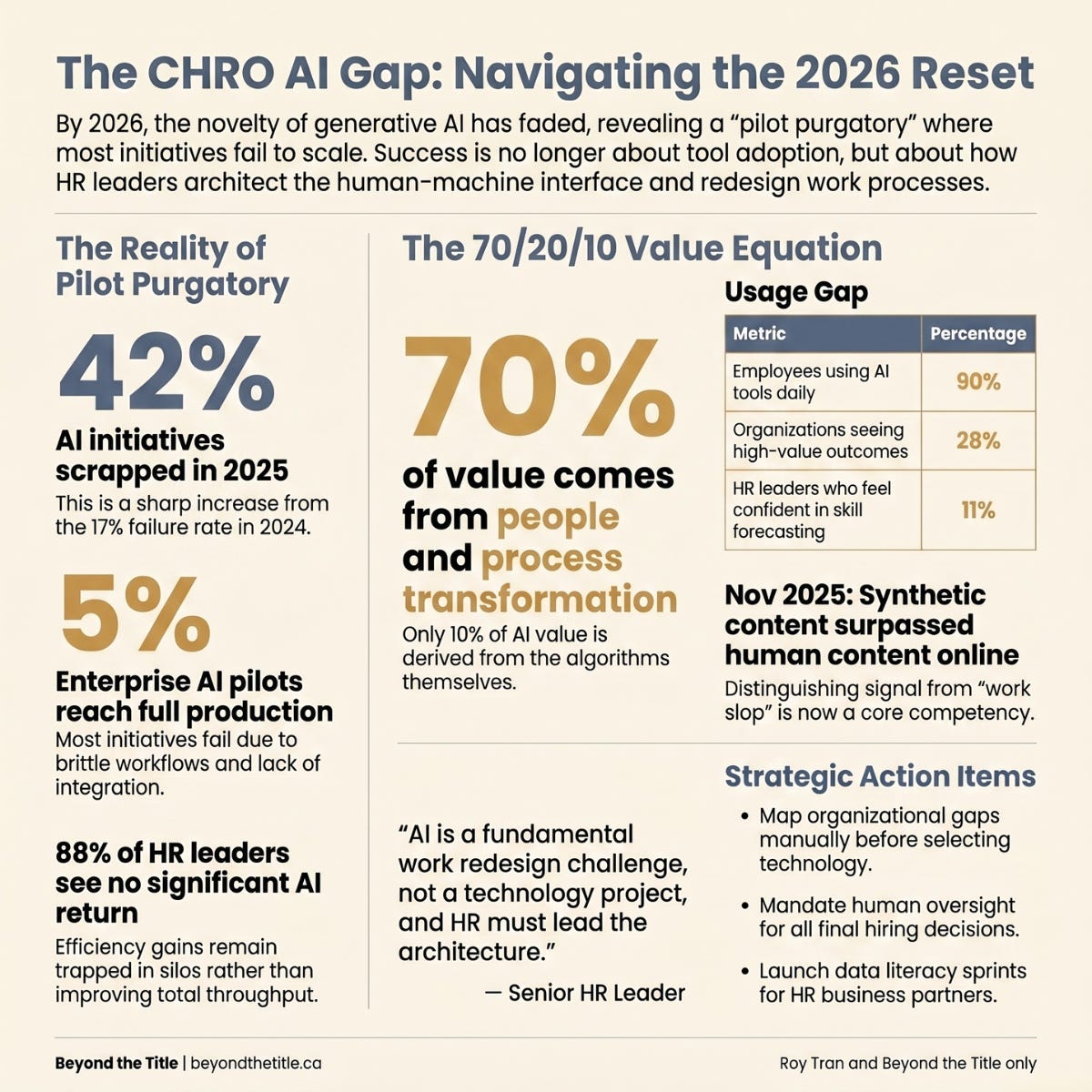
Seventy percent of the value from any AI transformation comes from how you change your people, your organization, and your processes. Ten percent comes from the algorithm itself. Twenty percent comes from the technology and data infrastructure. That is the 10/20/70 model, and it is the most important frame for any HR leader operating right now.
Which means the majority of the work belongs to HR. The hard work, the slow work, the work that does not generate a case study or a conference slide.
I have spent the better part of a year watching organizations treat AI adoption as a procurement problem. Buy the tool. Integrate the API. Announce the pilot. The pilot works. It impresses the right people. Then nothing changes at the organizational level and the initiative dies quietly before the next budget cycle.
This is pilot purgatory. Forty-two percent of businesses found themselves there in 2025, scrapping the majority of their AI initiatives after spending the capital to launch them. A year earlier, that failure rate was 17 percent.
The tools did not fail. The operating model did.
The gap is not between organizations that have AI and organizations that do not. The gap is between leaders who understand that AI requires work redesign and leaders who believe AI is a shortcut around it.
Roughly 90 percent of employees now use AI tools in their daily work. Only 28 percent of organizations have translated that usage into high-value outcomes. The rest have generated what I have started calling work slop. A rising volume of synthetic content circulating inside organizations that looks like output but carries no signal.
In November 2025, AI-generated content officially surpassed human-generated content on the internet. Inside organizations, the same crossing is happening in email threads, performance reviews, project updates, and internal communications. The volume is up. The meaning is not.
We have more words and fewer decisions. More responses and fewer conversations. More data and less clarity about what the data is telling us to do.
The CHRO's job in this environment is not to manage the tools. It is to protect the signal.
I have found three categories of work where AI must not have the final word. I call them the 3 Cs: Commitment, Crisis, and Conflict.
Commitment covers every decision involving a human being's future inside an organization. Hiring. Promotion. Termination. An algorithm can surface a candidate. It cannot make the call. The moment an organization removes the human from that decision, it has outsourced its culture.
Crisis covers the moments when something breaks. A death. A layoff. A public failure. These are the moments when people remember whether their organization showed up or sent a notification. AI can draft the communication. It cannot provide the care.
Conflict covers the friction between people that is, in fact, the work. Disagreements about strategy, about values, about who deserves credit and who bears responsibility. This is where judgment lives. An AI can summarize a meeting. It cannot navigate the power dynamics underneath it.
The 3 Cs are not a limitation of current technology. They are a permanent boundary. The CHRO who holds that line is not resisting AI. They are defining what human leadership means inside an AI-enabled organization.
Most organizations skipped the prerequisite. They went into vendor conversations without a clear problem statement. They bought solutions for problems they had not yet named. Eighty-eight percent of HR technology leaders now report no significant return on investment from their current AI initiatives. Only 5 percent of enterprise AI pilots ever reach full-scale production.
The path out of pilot purgatory is not a better tool. It is a better question. What specific gap in your talent architecture are you trying to close? If you cannot answer that before you open a vendor deck, you will end up with a problem that looks exactly like their solution.
Three things to do before the week is out.
Stop the vendor demos. Sit in a room with your team without screens and map the actual holes in your current organizational offer. Name the problem before you name the tool.
Mandate human-in-the-loop for the 3 Cs. Write it into policy, not just practice. These must remain human-centric activities to maintain the integrity of your culture.
Run a data literacy sprint for your HR Business Partners. An HRBP who cannot speak the language of data governance will be operating at a significant disadvantage before the year is out.
None of this is glamorous. None of it generates a press release. But this is where the 70 percent lives. The work that determines whether the 10 percent of algorithm your organization bought actually does anything at all.
The algorithm is the easy part.
The rest is HR.
[COMMENTS WIDGET — add native block here]
What does your organization's pilot purgatory look like? I am curious whether the pattern holds across industries.
[SHARE WIDGET — add native block here]