The Human Premium
The 60-Point Gap
What AI can do versus what it actually does
A few weeks ago, the CEO of Anthropic said something that should have produced a louder reaction than it did.
He suggested that AI could wipe out roughly half of all entry-level white-collar jobs within the next one to five years.
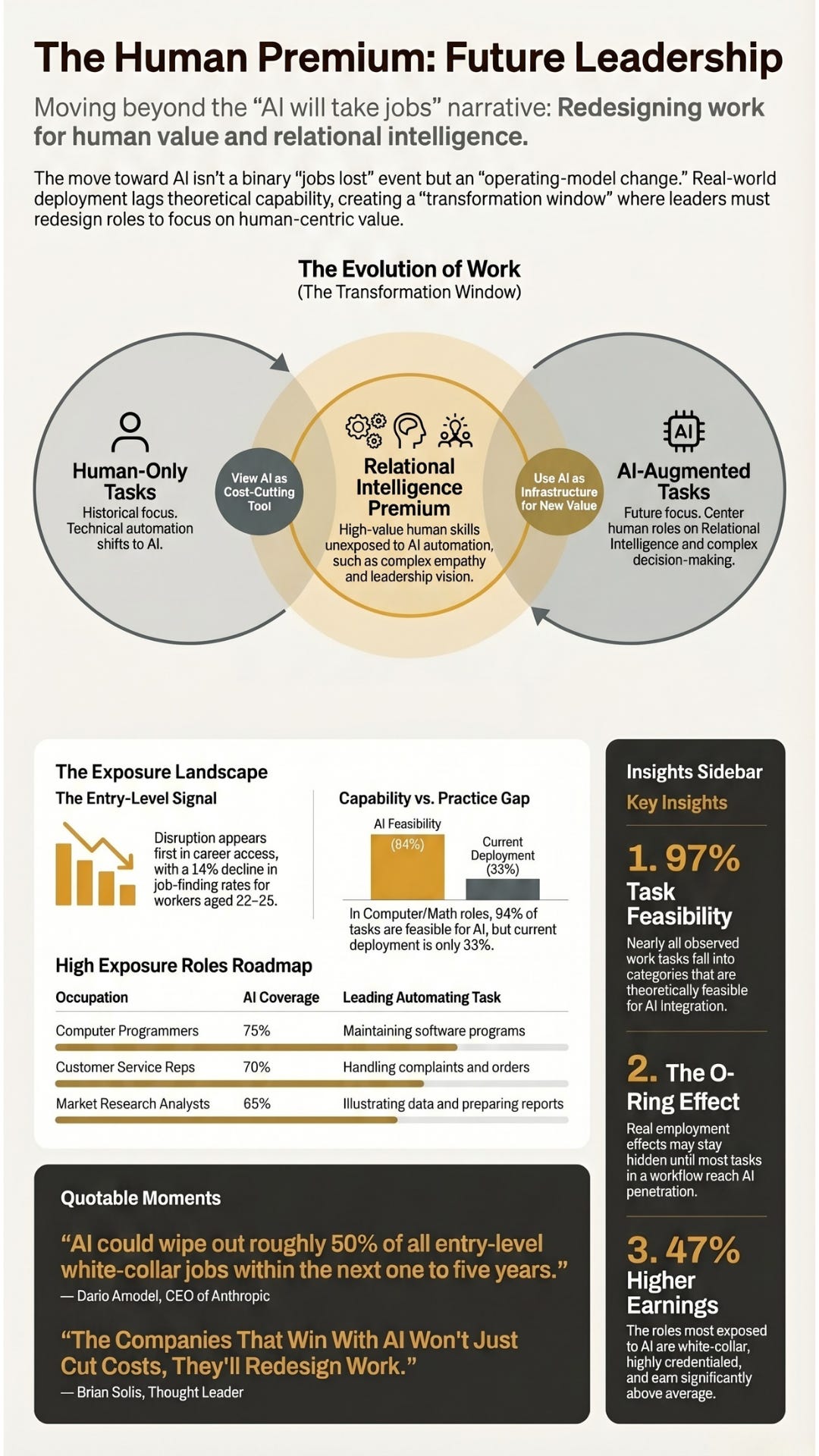
The reaction was muted. Not because people disagreed. Because most of us already feel it. The data is already moving in that direction. Job-finding rates for workers aged 22 to 25 have dropped 14% in the past year, with the steepest declines in the categories most exposed to AI.
If you have been hiring recently, you have probably noticed that the entry-level pipeline does not look the way it used to. The work is different. The expectations are different. The number of jobs at the bottom of the org chart is shrinking, even when the company itself is growing.
This is not nostalgia. It is the leading edge of something larger.
But here is the part of the story that does not get told as often.
If you measure what AI is theoretically capable of doing, the number is enormous. Recent research suggests that 94% of observed work tasks fall into categories that are theoretically feasible for AI integration.
If you measure what AI is actually doing in production, today, inside companies that have deployed it, the number is much smaller. About 33%.
That is a 60-point gap.
Sixty percentage points between what is technically possible and what is operationally happening.
This is The Human Premium territory. This is where the dividend lives.
In a previous essay I introduced the framework. Three capabilities that command a premium when intelligence becomes free: relational intelligence, ethical reflection, contextual interpretation. The framework is not aspirational. It is a description of what is actually happening inside the 60-point gap.
What the gap is made of
Some of the gap is technical. Models hallucinate. Integrations are expensive. Workflow tooling is immature. These will close, slowly, as the technology matures.
But most of the gap is human.
It is the work of deciding which AI output to trust. Of catching the errors that look right but are wrong. Of holding the room while a team adjusts to a new tool. Of explaining to a regulator, a customer, or a board why you took the longer route on a decision the model could have made faster.
The gap is the work that does not survive automation, not because the task itself cannot be automated, but because the consequence of getting it wrong is too high to delegate.
This is what I keep seeing inside organizations that are deploying AI well. They have not eliminated human judgment. They have moved it. The judgment work has migrated up the org chart, into the gap. The people doing the most valuable work are increasingly the ones who can interpret, interrogate, and own the AI output, rather than the ones who can produce it.
The O-Ring Effect
There is a concept from labor economics called the O-Ring Effect. It explains why some workflows fail catastrophically when one component fails, even if every other component is operating perfectly. The space shuttle Challenger was the original O-Ring. The whole launch failed because of a small seal that got cold and lost its flexibility.
In AI deployment, the O-Ring is human judgment.
Most of the productivity gains from AI sit on the other side of a single component. If a leader cannot interpret the output, hold the team through the change, or take responsibility for the decision, the entire deployment underperforms. The model is fine. The data is fine. The integration is fine. But the workflow stalls, because the human O-Ring at the top of the workflow is not in place.
This is why the 60-point gap stays open. Not because the technology is missing. Because the human capability that closes it is rarer than we expected.
The earnings signal
Here is the data point that surprised me most when I started looking at this seriously.
The roles most exposed to AI, the ones where the model can do most of the underlying task, are also the roles where humans who use AI well earn significantly above average. One study put the premium at roughly 47%. The exposure does not destroy the earning power. It concentrates it. Around the people who can hold the gap.
This is the asymmetry nobody is talking about clearly.
If you are afraid that AI will commoditize your work, the question is not whether the model can do the underlying task. It probably can. The question is whether you can do the work that lives in the 60-point gap.
If you can, your earning power goes up.
If you cannot, it goes down sharply.
What this means for leaders
The hardest part of this is operational, not philosophical.
Most companies are still measuring AI deployment in terms of efficiency, cost reduction, time saved. These are real numbers. But they are not the leading indicator of which companies will be standing in five years.
The leading indicator is whether your leadership has the capability to hold the gap.
Whether you have leaders who can interpret model output and decide which version of the answer to use. Whether you have leaders who can hold a team through repeated workflow redesigns without losing the trust that makes the team functional. Whether you have leaders who can take responsibility for an AI-influenced decision when it lands wrong.
If you do, the 60-point gap is your competitive advantage.
If you do not, no amount of AI deployment will close it.
The companies that win with AI in this decade will not be the ones who automate the most. They will be the ones who hire and develop the most capable humans for the gap.
That is what The Human Premium is paying for.
It is not paying for nostalgia about human work. It is paying for the rarest commodity in any AI-deployed organization. The leader who can hold the part of the workflow that the model cannot.
The 60-point gap is not a weakness in the technology.
It is a description of where the next decade of leadership careers will be decided.
If you have seen the 60-point gap close inside your organization, I want to know how it closed. Was it a single leader. A new structure. A specific habit. The mechanism is still becoming clear to me, and what I am missing matters more than what I have already named.
The person who comes to mind right now is who this was written for.
Send it to them.